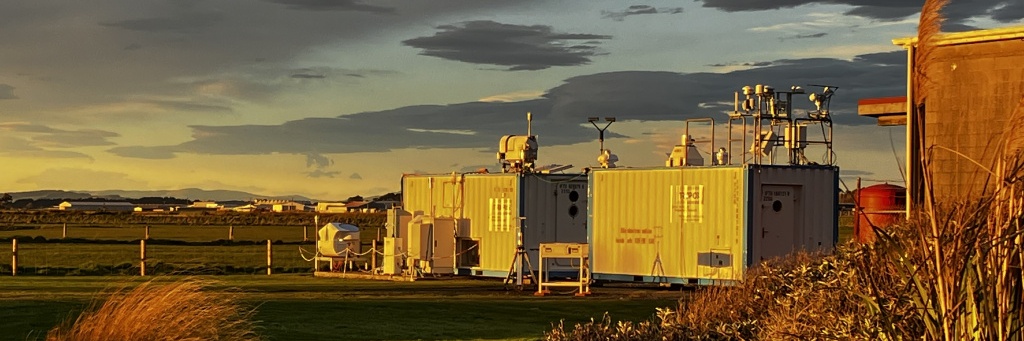
Figure 1: The LACROS site in Invercargill at sunset. Photo by Lukas Pieper.
A Year of Measurements
On 24th of August 2026 our measurement site in Invercargill, Aotearoa New Zealand reached an important milestone: One full year of continuous operation, with almost no data gaps! This gives us a unique dataset of the complete annual cycle in the Southern Ocean region.
Over the year, we have captured a wide range of atmospheric conditions, including storms, frequent warm rain events (rainfall produced by clouds that do not contain ice), Australian wildfire smoke reaching the site, and detailed observations of the local boundary layer.
First Statistics of the Annual Aerosol Cycle
Figure 2 shows the average aerosol backscatter coefficient at 532 nm between August 2025 and August 2026, split into 3-month periods. All periods of at least 30 minutes of continuous clear sky during night time were analyzed using the Raman lidar method and averaged to produce one profile per period.
In the boundary layer, the picture shifts clearly with the seasons: winter and early spring show lower backscatter values, around 1 Mm⁻¹sr⁻¹, while summer values are roughly double, around 2 Mm⁻¹sr⁻¹. At the transition between the marine boundary layer (MBL) to free troposphere (FT), backscatter drops sharply by one order of magnitude, then continues to decrease more gradually with height. When reaching the tropopause, around 10 km, it has dropped by roughly another order of magnitude.
Between 10 and 20 km, backscatter levels off and stays fairly constant, with a slight tendency toward higher values in winter than in summer. Higher winter values are potentially linked to the presence of slowly decaying sulphate aerosol emitted into stratosphere by the Ruang volcanic eruption. Between 20 and 30 km, backscatter decreases by a further order of magnitude.
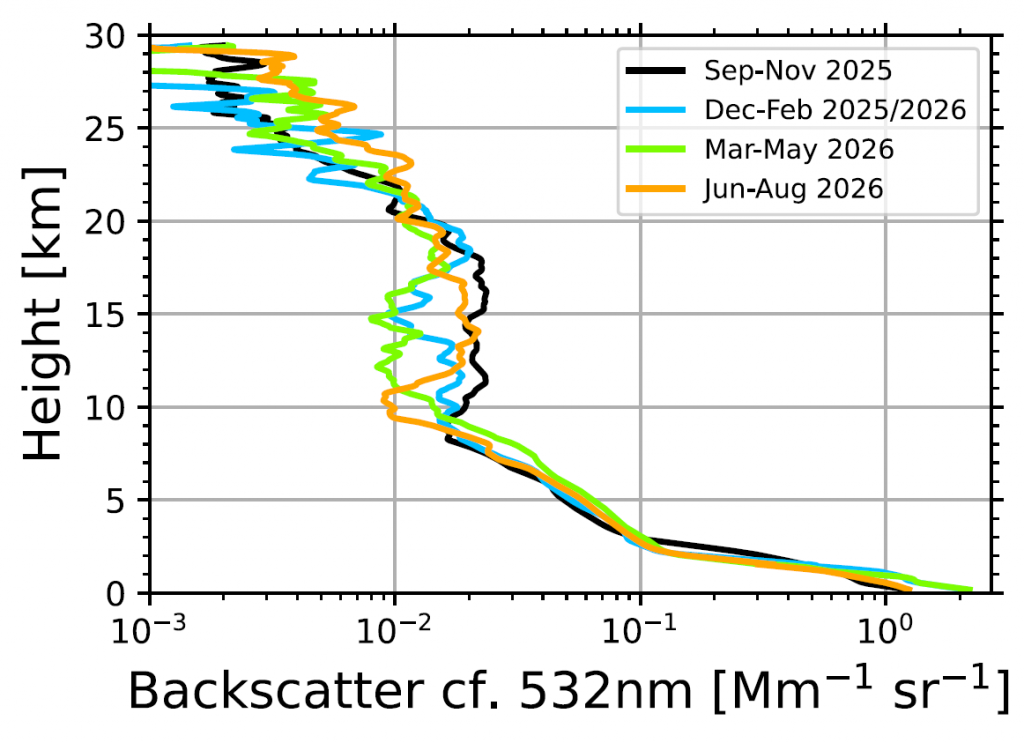
Figure 2: 3-monthly averages of aerosol backscatter at 532 nm between August 2025 and August 2026.. Statistics by Kevin Ohneiser.
Calibration and Maintenance
A full year of observations, including almost six months of unsupervised measurements, doesn't come without wear and tear. To keep data quality high going forward, we carried out a round of maintenance and calibration:
· Liquid nitrogen (LN2) calibration of the RPG 94 GHz cloud radar and microwave radiometer (MWR)
· Exchange and realignment of optical elements in the PollyXT lidar setup
· Minor repairs and improvements to the Metek Mira 36 GHz cloud radar
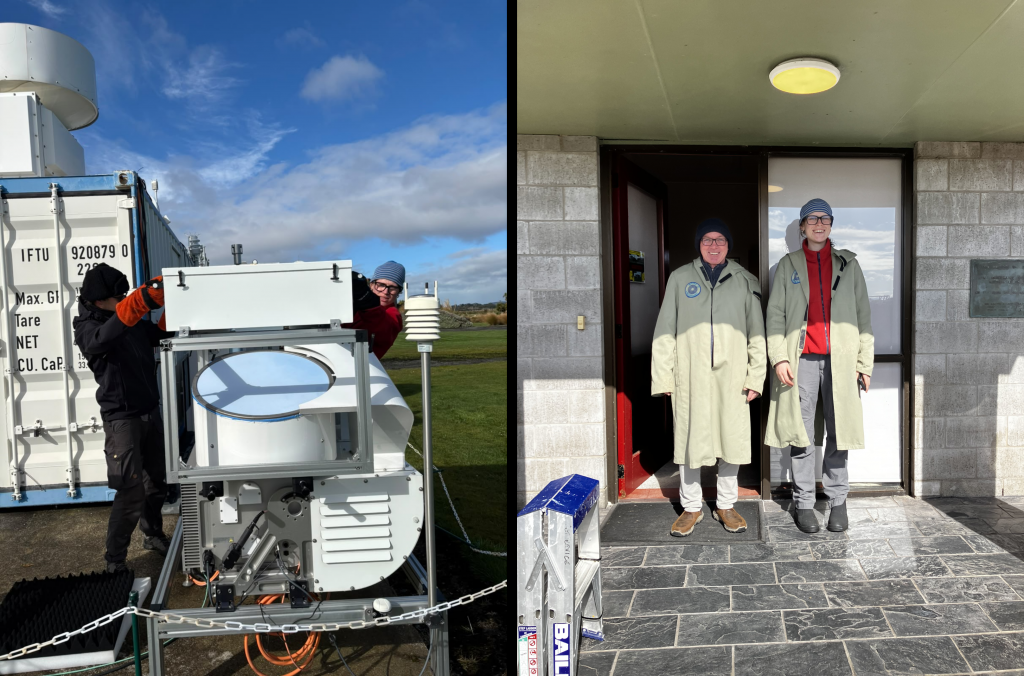
Figure 3 +4: Left: Freya Coulson and Lukas Pieper place the calibration target on the RPG cloud radar; Right: Andy Fraser (MetService NZ) and Freya Coulson getting ready for radiosonde launch. Photos by Guy Coulson and Lukas Pieper
Visit from Colleagues of The Air Quality Collective and University of Auckland
The maintenance work also brought some welcome company: Freya Coulson, research assistant at the Air Quality Collective and chemical engineering student at the University of Auckland, and Dr. Guy Coulson, Director of the Air Quality Collective and former principal air quality scientist at New Zealand's National Institute of Water and Atmospheric Research (NIWA), visited the site to help with instrument calibration.
Freya also collected the Ice Nucleating Particle filter samples gathered over the past year, which she will bring back to Auckland for analysis under the supervision of Dr. Joel Rindelaub.
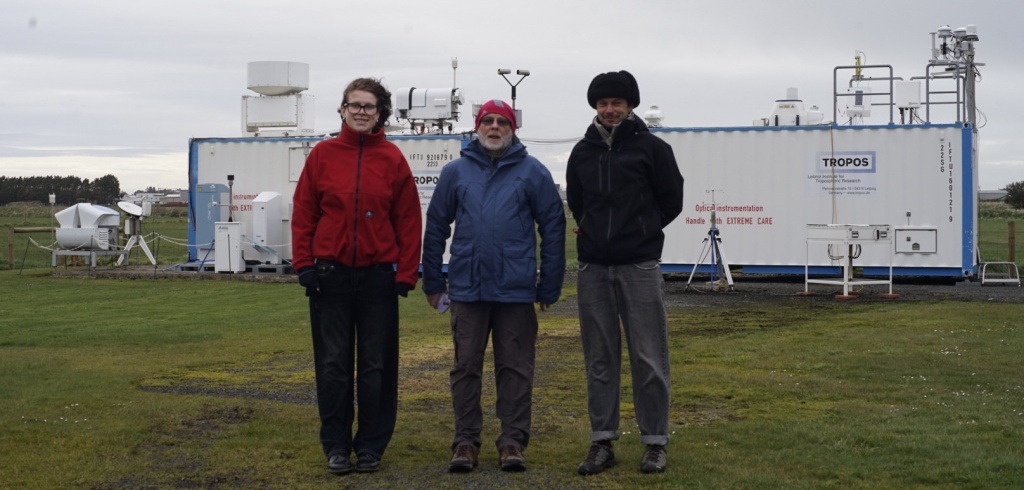
Figure 5: Calibration team in front of the LACROS measurement site. From left to right: Freya Coulson, Guy Coulson and Lukas Pieper. Photo by Lukas Pieper.
Authors: Lukas Pieper and Kevin Ohneiser